What’s Worth Living For?
If something you loved were threatened, how far would you go to protect it?
Most of us have a limit to our activism. If we’re troubled by something, we might ask, “What can I do?”—but we want the answer to be easy. We might send a small amount of money or help spread the word. If we’re really troubled, we might try to recruit others to join our cause.
Some people go further.
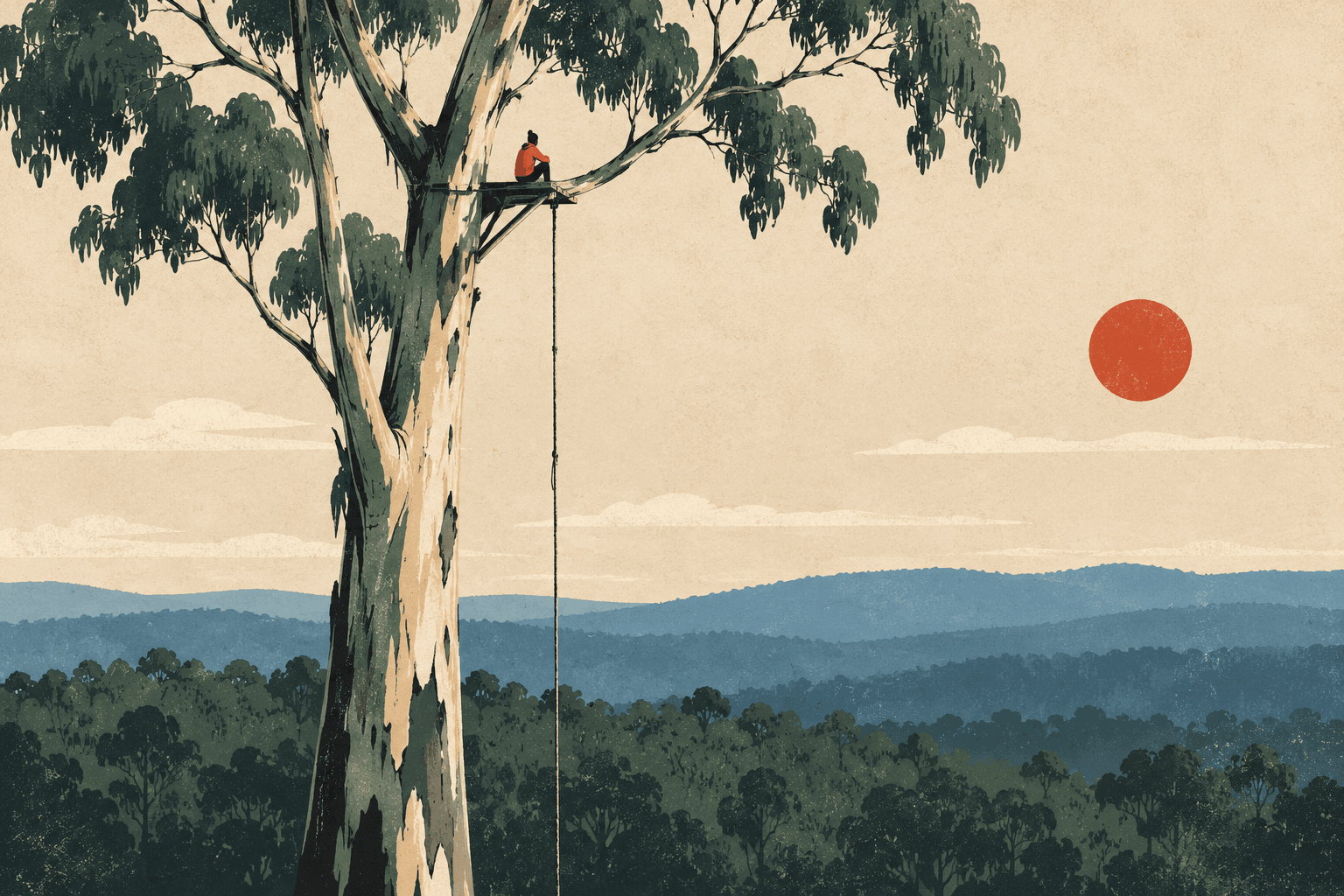
449 days in a tree
Miranda Gibson, a 30-year-old Australian from the island of Tasmania, was troubled by the spread of industrial logging in her homeland’s ancient forests.
As a child, Miranda had walked through forests thick with hundred-year-old trees that were now being felled at an alarming rate, despite the area’s having been nominated as a World Heritage site.
Other people were troubled too, but few were willing to sacrifice to create real change.
Miranda decided to become a living example of activism, doing whatever she could to bring awareness to the cause and stop the industrial logging. Her means of protest? She climbed to the top of a 60-meter-high eucalyptus tree…and told the world she’d stay there until the problem was solved.
What’s life like at the top of a eucalyptus tree?
An installed platform provided a vantage point to observe the forest. Tasmanian devils caused trouble on the ground. Owls awakened and said hello to their neighbors. Outside visitors came and went through an improvised pulley system.
But the visitors, the messages, and even the noise from the owls were blips on a continuous radar of monotony. Mostly, there was a lot of solitude.
“Sometimes it gets lonely up here,” Miranda told me by email, in what seemed like the understatement of the century.
The loggers left the immediate area. But Miranda’s goal wasn’t to make them disperse for a while; it was to make it illegal or impossible for them to return.
She stayed in the tree for weeks, and then months. The seasons changed and she was still there. An entire year passed, and she hadn’t moved.
I corresponded with Miranda around Day 400 of her protest. She’d recently celebrated her second Christmas high above the earth. We arranged a Skype session through what was perhaps the world’s only Wi-Fi hotspot at the top of a hundred-year-old tree.
“Why do this?” I asked. “Why you?”
“This is what I knew I could do,” she said. “Nothing else seemed to get attention.”
A more interesting question
One online commenter wondered about Miranda’s motivations: “Is she doing this to make up for something lacking in her personal life?”
But you could ask the same thing about anyone devoted to a cause. Who’s to say why anyone cares about anything? If you’re willing to spend a year living in a tree, you have to believe in something.
When I was a kid, I sat in the back of a lot of dramatic, late-night church services.
Often the preacher or evangelist would tell a story about our fellow Christians in Russia, China, or Cuba—communist countries were seemingly interchangeable—being surrounded by soldiers in a church and forced to recant their faith or risk execution.
No matter the details, the story was always followed with a challenge: “Would you be willing to die for your faith?”
Looking back, it’s easy to see how limited this question was. What’s worth dying for? That’s hard to answer. Rarely does anyone get a say in how they die and whether it’s for some kind of cause. Most of us die whenever the time comes around, whether we’re prepared to make some kind of statement or not.
And yet, every single day, all of us get to answer a far more interesting question:
What’s worth living for?
If you could only pursue one thing, what would you craft a life around and do every day? And what if real sacrifice was involved…would you stick with it?
Dying for something is heroic. In the rare case that it happens, you go down in a blaze of glory, clutching to your morals or cause. Nice work if you can get it. Years later, a famous actor will play you in the movie.
But living for something can be mundane—and therefore far more sacrificial, because seldom does anyone else notice.
You just go on living, beating the drum for the thing you’ve chosen to value above all else. Genuinely living for something, day after day, is much more valuable than looking for the blaze of glory at the end.
After 449 days, Miranda had to come down urgently. A bushfire burned to within a kilometer of her tree.
During the entire protest, she had worn a safety harness. When she came down, she continued wearing it until someone pointed out that it was no longer needed. Reporters and photographers awaited her arrival, and she sat by the tree holding the rope for a long time.
Finally she concluded that she’d proven her point and walked away. If the logging companies returned, she’d be ready and willing to do it again.
So what do you think: what’s truly worth living for?
Whatever your answer is, keep it in mind as you make decisions.
Miranda’s story comes from The Happiness of Pursuit, my book about people who organize their lives around a quest.