)
Visit to North Korea (Sort Of)

On my last trip to Asia, I stopped off in Seoul for an important side-trip.
I’d been to South Korea three times before, and each time I’d tried to make this side trip—but each time, something came up to block my way. A public holiday was announced, or I came on the wrong days of the week, or hostilities between neighbors had erupted that derailed the plan. Each time I flew back to Hong Kong or Japan, resolving that the next trip would be successful.
After three failures in three years, I was getting tired of going back and forth, so I tried to plan better this time. I made a reservation two weeks in advance with this company (there are others and they all seem to be fairly similar). I followed up several times by email, and again by phone after arriving in Seoul. Then on a Saturday morning, I walked over to the Lotte Hotel and checked in with my passport.
I was going on a field trip to Panmunjom, the village that serves as the dividing line between North and South Korea. For about $72 USD, non-Korean passport holders can go on a carefully escorted tour which guides who explain the history of the conflict. And for a few minutes, you can enter the conference room where both sides meet (always with international mediators) and wander over to the North Korean side.
The only other way to visit North Korea, aside from being kidnapped when wandering too far from the South Korean side, is to schedule a real tour that leaves from Beijing. I’d actually like to do it at some point, but I also wanted to get this “sort of” visit to DPNK out of the way first. It’s not ideal, but if I have to count the side trip as a country visit, I can do so.
I was worried that the tour would be boring or kitschy, but in fact it was well worth the effort and expense. I left with a group of other foreigners in a bus from the Lotte Hotel and rode 40 minutes out of the city, stopping for lunch at a restaurant. They had one vegetarian choice, a non-meat version of some nice Bibimbap, which I enjoyed with a Diet Coke.
Back on the bus, we heard more about what we would be seeing that day, and were given multiple reminders of the rules during of the tour. Photos could only be taken at specific points; all other times, the cameras had to be stowed out of arm’s reach. A dress code was enforced. You must obey the soldiers at all times, etc. All of this probably sounds fairly basic, but when you tour the DMZ, you quickly realize that the atmosphere is tense. When we arrived at the first of several checkpoints, a guard came on the bus for a second dress code inspection, and reminded everyone that we are entering an area where we would be closely monitored. When we got off the bus to go inside for another briefing, we had to sign a waiver stating that “injury or death may occur during a visit to an active military conflict zone.”
After all the briefings, we went on a separate bus and rode through the village. South Korean passport holders aren’t allowed to go on the second part of the tour; they have to wait at the earlier checkpoint for the rest of us to return. Sorry, guys! The group going the whole way included other Westerners, Japanese, and some second-generation Koreans from the U.S. and Canada.
The South Korean government wanted to encourage citizens to settle in the village, our guide told us, but it was a hard sell. Not only was the village an hour away from the nearest Dunkin’ Donuts in Seoul, the North Koreans also had a bad habit of coming across to kidnap villagers. The govenment decided to offer a big list of incentives for families who agreed to stay: first, they pay no taxes, second, the rice they grow can be sold at a subsidized price for higher profit, and third, their sons are exempt from the mandatory two-year military service that every other 19-year-old male has to complete.
The upside of this arrangement is that some farmers make $80,000 a year thanks to the tax waivers and subsidies. The downside is that the farmers could be captured or killed by the North Koreans at any time. Hmmm … tough choice!
We also heard about some of the incidents that have taken place since the DMZ has been in existence in 1948. In 1976, North Korean soldiers murdered two American soldiers who came to trim the branches of a tree obstructing the view. (We saw the area where the incident took place, but not surprisingly, the tree has long been removed.)
We drove past the bridge of no return, where Korean prisoners of war of both sides were once allowed to choose where they wanted to live—but only once. In 1984, a Soviet defector ran across the bridge in pursuit of freedom. He made it, but four soldiers were killed in the ensuing firefight. Non-conformist that I am, I had the strong impression that it was probably best to follow orders on this tour.
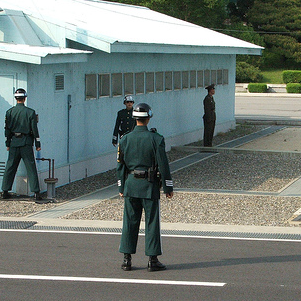
Finally we came to the high point of the visit—the actual military and political space that divides the countries, and where they meet whenever they agree to talk shop. Soldiers from both sides of the conflict stand guard, watching each other warily. The Republic of Korea (ROK) soldiers from South Korea stand motionless in a neutral Taekwondo stance, wearing heavy gloves and dark sunglasses, never shifting their gaze in a way that is obvious to anyone watching. From time to time, we were told, the North Korean soldiers provoked them by making faces or extending a middle finger, a gesture that has made the cross-cultural adoption to the communist world. The South Korean soldiers are not allowed to respond to the taunts and must always remain neutral.
We were then given yet another briefing by an American soldier, who led us into the conference room. In the room itself, one ROK soldier stands upright and motionless, watching over the area. This soldier must also be a good mime, because he has to tolerate all of the tourists coming to stand next to him and get their photos made.
 really North Korea, but it was probably as close as I was going to get for a while.
Here’s a short video of one of the many briefings we received. The conference room building can be seen in the middle left. Across the way, North Korea stands on watch.
***
On the way out we rejoined the South Koreans who had been waiting for us as we went on the second half of the tour. I avoided the gift shop, where visitors can buy Kim Jong-il lighters to go with duty-free Marlboro cigarettes. The gift shop was probably the only kitschy thing about the tour; everything else was more interesting than I expected. I would have preferred not to travel on a group tour with 40 other visitors, but that’s how it works when visiting an active conflict zone—take it or leave it. I was glad I took it.
If you ever have the chance to spend time in Korea, I definitely recommend you set aside a day for this side trip. I know some of our readers have been to “real” North Korea as well, by traveling through Beijing on an official, week-long visit—my respect and congratulations to all of you. I hope to get there for a longer stay at some point, but for now, I’ll take what I can get.
###




42 Comments
Great post, Chris. It’s really cool that you not only visit these countries, but provide us with a history lesson too. North Korea seem like a fascinating place, if for no other reason than it’s so different from the US or any other Western country.
Thanks for sharing…
Full marks for creativity!
Reminds me of a radio piece I heard about a (the only?) US soldier who defected to North Korea. He ended up working in the North Korean film industry playing the American bad guy in all the propaganda movies. He apparently went on to be relatively famous. It’s a strange world.
I was in Soviet occupied Lithuania in the late 80’s and although there was palpable tension while entering the U.S.S.R., it was not nearly as extreme as what you describe here. Thanks for the interesting insights into a country most people will never visit.
Great post, Chris! It shows one of the great powers of travel: being able to stand and breathe where history and conflict happened (or are happening). I’ve always been curious how you would pull off North Korea. Thanks for this one.
Thanks for sharing this story – fascinating!
Did you get any stamp on your passport? 🙂
Wow, Chris, perfect timing. I’m moving to Seoul within the week to teach ESL for a year. I saw a documentary a couple months ago that of course talked about the border. I didn’t realize, though, that the tour let you step across the line. For $72, that’s definitely something I’m going to check out. I’m really glad it was something you recommend, not just some gimmick.
Thanks, guys. As mentioned, I still hope to get over to the “real” North Korea at some point. One thing at a time.
@Etsuko,
Nope, no stamp. These days I don’t always want stamps because my two passports are already quite full, but I would have taken a DPNK one if they offered…
Great story Chris. I also love how you provide us with the history and backstory of the places you visit.
Btw, have you seen the video on North Korea on Vice (VBS) tv? They sneak cameras into the tour from the north and that place is a whole ‘nother world, it’s almost unreal.
Have you just been there recently? I also planned like two weeks in advance for a tour to Panmunjeom, but the day before the tour, the North Koreans bombed that little South Korean Island (It’s all over the news), then my trip was cancelled. So I completely can relate to your frustration and disappointment when you couldn’t make it three times.
I am glad the tours are now resumed. I hope to go there someday!
Very interesting – I’ve been to S Korea while in the military, and saw plenty of Korean armed soldiers and tanks during my stay there, but never knew about this piece of their history. Considering what you had to go through to get to that meeting room, I wonder if non N Koreans (but friendlies) are permitted to do the same from the other side? I’m guessing not considering the clench the government has on everything.
I WILL make it to NK one day. It’s gonna happen.
Great posting. When I visited the border, North Korea was playing propaganda from the other side. Crossing over to the “other” side was surreal.
Hey Chris – Thanks for sharing. Sounds like a fascinating experience. If you haven’t seen this from the guys at Vice, I highly recommend it: http://www.vbs.tv/watch/the-vice-guide-to-travel/vice-guide-to-north-korea-1-of-3.
They get into North Korea with a camera. It’s rivoting stuff.
Take care,
michael
How bizarre a world this is, truly surreal, only it IS real. Makes me wonder why it is that humans have created things to be this way. Rather sad, really.
Awesome post. I am a big-time history nerd and I would have loved that tour! Something to add to the life list.
I heard that going through Beijing is really difficult too…I remember I once read a blog on one persons experience and it’s insane what you have to do. I also remember I read about these denim designers from Sweden? I think who got permission to work in North Korea and when the time came to sell the jeans most companies refused because of the conflict…I read about this probably last August. Not sure what happened. Anyway I would probably be tense to visit I think most American’s are especially after seeing some of the video come out of there. Corrupt government that it is it’s hard to fight them when they have China so close watching the outcome, which sucks because obviously the North Koreans aren’t as well off as there leader would like anyone to believe. Well hopefully you get to visit deeper in someday that would be an amazing experience.
Good post. I just finished reading Nothing to Envy – Ordinary Lives in North Korea (pretend like that’s underlined) by Barbara Demick so was really interested in your experience.
I went on this kind of tour a few years ago. I was also worried that it was going to be lame, but I agree that it is well worth the effort and expense. Thanks for reminding me of a great day from my past travels:)
Great post. I never knew that you could do such a tour. I will definately do this on my next stop over in Korea which will probably be in November.
I live in Seoul but have never been to the DMZ. I guess I should visit it over the summer. Seems very interesting.
I did this same trip almost 10 years ago, and it sounds like it hasn’t changed – it’s a pretty serious day, isn’t it. I remember we weren’t allowed to wear jeans (have they relaxed that rule?) and they kept telling us not to point to the north side – of course I just couldn’t keep my arms still then, it was awful! Thanks for reviving my memory of that interesting day.
My wife and I did the trip from Beijing in 2006 to Pyongyang (in a complicated tour accompanying a Chinese youth orchestra). Things were a little surreal at a ‘state’ level – for example we stayed in a 20 story “5 star” hotel and occupied the only level which had the electricity on. We met many people who were friendly on the surface but who, at the next level down had been brainwashed to resent us. I am no amatuer psycho-analyst but I did feel that somewhere, way down there there was a recognition that we are all the same. The pro-Kim mentality may be a front they must display in public (all public, not just in front of foreigners) but what worried me a little more is that the Anti-Americanism seemed even more deep rooted (we are not American). I remember thinking this was dangerous and then we got back to Beijing and I switched on “The Situation Room” with Wolf Blitzer and realised the brainwashing works both ways……I look forward to your post if you do make it, difficult not to treat like a bit of a ‘zoo’ where you can gawp but not talk to those who live there. Sure you’ll manage though.
Neat! I’ll be doing this very trip (with the USO tour group) in a few months when I have a day-long layover in Seoul!
Can you tell us more about the dress code? Were people wearing shorts or should I plan on wearing long pants?
Also, as it’s a layover I’ll have a bag with me with a few items like books and a laptop. Will I be fine to take it along or should I rent a locker at the airport?
My mother-in-law is from North Korea. Tales of her childhood under Japanese occupation, then liberation, then time in a Communist prison camp are hair-raising. That she survived to leave Korea and start a new life in America is a testament to her personal strength and character — she is an amazing woman.
And b/c of her stories, I really don’t want to honor North Korea with much interest. I’m curious, but the government continues to foster war attitudes. It’s sad. My mother-in-law lost her whole past,although she did manage to reunite with her mother and sibling after the war — the rest of her family and home are just gone to her — unthinkable for a culture so based on family.
My husband and I have been to Seoul twice and loved it. We even had the opportunity to meet with a penpal and visit other parts of Korea — what a beautiful country — warm people and spicy food!
With my son wanting to join the Army today, his 17th birthday, I could not help but feel like a mom who worries about the future of North Korea, Afghanistan, Iraq, and the Middle East.
It’s truly amazing just how much meaning man can ascribe to lines on a map. Some borders, such as the four corners in the U.S., barely register or have any meaning. It’s extremes like N.Korea that define words like “border.” You’ll probably look at all the “easy” border crossings in a different light after going through all this.
Such a bizarre place and circumstances. I have only ever seen this place in one of the “Where the Hell is Matt?” videos 😀
It was great to read your accounting of going there. Amazingly, I’ve been there too. In 1987 when I was 17 I was a People to People High School Ambassador. We went to six countries in the summer, stayed with families. We went to the DMZ. What I remember is an official, uniformed person getting on the bus and saying to us “No checki checki!” They didn’t even look at our passports.
Did you get to learn about the Tunnels of Aggression. It was amazing for me to learn about that. We were in South Korea for a week, the first week of our trip, this was part of it. I, too, consider it an honor to have been there…and I count it as one of my 20 countries.
OK, Chris, honestly. What are you doing drinking Diet Coke?;-)
My son is in the Air Force. He is due to transfer soon (just came back from Afghanistan). One of his choices is Korea, probably Osan Air Base. I’ve been there many moons ago and wanted to see more of the country. Unfortunately, we were on our way to Taiwan and didn’t have the time.
What other countries are going to be a problem for you to visit? I was thinking about that the other day.
I went to Pyongyang once. . . for about 10 minutes. I was part of a U.S. Army detail who were allowed in country long enough to pick up alleged remains of fallen soldiers from the Korean War. We had to fly from Seoul to Tokyo to Pyongyang so as to not cross the DMZ. As soon as we touched ground, we loaded the aluminum caskets as fast as we could, gave a quick salute, and jumped right back on the plane. Certainly one of the more memorable moments of my time in the Army.
So you came to my neck of the woods and didn’t even bother to say hi? LOL – I’m about two hours away and would’ve been working, so no biggie.
That North Korea experience is about as close as most people get to the forbidden country. You were right to avoid the nonconformist attitude here – people holding machine guns tend not to be the most easy-going people ever.
I, too, did the trip last year. It wasn’t until we were on the bus heading north that I asked the tour guide why flipflops weren’t allowed…. the answer was “in case we need to run”. But, my overriding memory was of the flocks of white cranes which have populated the DMZ because, for them, it is a safe haven and a very small silver lining in a very big dark cloud.
As a South Korean, it’s great to read about your experience at the DMZ. I recently heard about a Swedish/Norwegian company making jeans from the DPRK. I did wonder how companies can conduct business with such a tumultous country.
Hey Chris! I was just at Seoul too last April 29,2011 and came back to China May 3,2011. Was at the DMZ but since it was a Sunday – didn’t get to do the complete Panmunjon tour but just the 3rd infiltration tunnel, Dora station and observatory. My friend accidentally took a photo of a military base and camp and the Korean soldier confiscated the camera from her and deleted the photo
Hoped to someday do the North Korean tour. My Chinese student did it from her hometown in Jilin which borders North Korea but don’t know if they would cater to foreigners. My only fear is that should I get the North Korean stamp, would that deny me access to other countries just like the Israel stamp would restrict you traveling to Lebanon. But I heard that North Korea gives you a retractable page in your passport for them to stamp so you could get rid of it later on. Don’t know if that’s true
As an American citizen who hopes to visit North Korea someday, I just want to mention that the correct abbreviation is DPRK. 🙂
You should definitely set aside the time (and money) for a real visit to the DPRK, it’s worth it. … And thank you for sharing your experience of being in North Korea “sort of”. So that’s what a tour from the other side is like. When we were in the DMZ, there were no tourists on the other side, or I’d have waved to them.
Shame, I forgot to cross the border “sort of” because we were all so busy taking pictures. So I haven’t been to South Korea.
Simply want to say your article is as surprising. The clarity for your put up is simply great and that
i could assume you’re knowledgeable on this subject. Well
with your permission let me to seize your feed to stay up to date with approaching post.
Thanks one million and please carry on the enjoyable work.
It’s really a great and helpful piece of information. I am satisfied
that you simply shared this useful info with us. Please keep us informed like this.
Thanks for sharing.
This is a great article, Chris, very informative! I’m actually heading to Beijing and then to Seoul next week to do the same thing and this article was very helpful. I, too, was wondering if I should count North Korea as a country I’ve visited if I only cross the border by doing the DMZ/JSA tour. I definitely want to go back again and do the “real” North Korea by flying into Pyongyang or taking the overnight train from Beijing. Let me know if you end up doing that trip!
Your comments are welcome! Please be nice and use your real name.
If you have a website, include it in the website field (not in the text of the comment).
Want to see your photo in the comments? Visit Gravatar.com to get one.