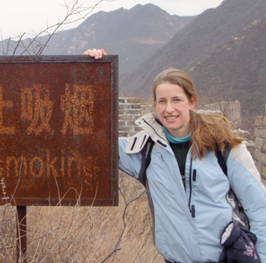

Thank You for Not Smoking… in China

Sometimes I find out about people who read AONC and I think, “Really? They care about what I have to say?” I think it should be the other way around.
Dr. Sarah England is one of those people. She wrote in to thank me for the World Domination manifesto and I thought, “Hold on a minute! I should be thanking you for being awesome.”
After stints in Vietnam, Switzerland, and elsewhere, Sarah moved to China with her family to work against the tobacco industry. As she mentions below, attitudes toward smoking in Asia are slowly changing, but there’s still much less awareness than in the western world.
I asked Sarah if she’d share a few things about her motivations and the work itself, and she graciously agreed. Note that Sarah serves in China at the invitation of the government, so we avoided much political talk in our conversation.
Our Q&A is below.
***
What drew you to uproot your comfortable home and life to crusade for the health of millions of people you would otherwise likely never meet?
When I took this job and left my comfortable life in Geneva I got an email from a friend saying “You are still changing your clothes in telephone booths!” I loved it. I printed it out and carried it in my wallet and when things were very tough here my first year, it kept me going. I guess there is a kid inside me who still wants to be Superman and do something selfless and heroic.
What, if anything, prepared you to tackle this challenge? What do you wish you had known in advance?
I had spent many years working on political advocacy in the fight to stop tuberculosis (Stop TB). That work taught me how important it is to build coalitions to tackle a huge problem like TB or tobacco. I had worked in Asia previously, in Japan, Vietnam, Laos, and Cambodia, so I had some familiarity with the region and especially with communist systems of government.
I wish I could have come to China being able to speak, read and write Chinese fluently. I still can’t speak or read Chinese at more than survival level. That is a major regret, but there are just not enough hours in the day.
Your passion and ambition have brought you to many places. Do you ever crave greater stability or a more traditional lifestyle? If so, how do you deal with these feelings?
I fantasize about building a log cabin on a lake in Canada that we could all call home.
How did you talk with your family about moving to China, and how did you eventually decide to take the leap?
The kids were excited about coming from the start. They were three and five and at that age, it was just a big adventure. My husband is a physicist, and once we knew we were going to China, he managed to get himself invited as a visiting professor to China’s top science university. He’s been having quite an adventure here, too.
How is your family enjoying your new lifestyle? When there are problems, how does it affect your relationships?
The kids miss some things about the countryside near Geneva where we lived before, like our big dog (big dogs are not allowed in Beijing), and playing in the woods. But China is a fascinating place and Beijing can feel like the center of the world. Since we came in 2008 we have been to the Olympics, the World Expo and we have seen two total eclipses of the sun—one in Xian and one in Hangzhou. The craziest thing about moving here is that after a couple of years, China is beginning to feel like home.
Some schools in China are sponsored by tobacco companies. How do you deal with that potential conflict?
The Chinese public health community is taking this matter very seriously. But the Chinese government owns the biggest tobacco company in the world, and produces by far more tobacco than any other country in the world. This earned the government about 65 billion dollars from tobacco last year, so you can imagine the forces at work here.
There are Chinese NGOs that are very active on this matter, such as the Chinese Association on Tobacco Control. We support them as much as we can, but they are the leaders, not us.
What has been your biggest frustration of working in cooperation with the Chinese Government?
The National People’s Congress of China has ratified the WHO Framework Convention on Tobacco Control which means it is binding law in China. The Ministry of Health is fully committed to tobacco control and we do our best to support them with high level political advocacy.
However, there are always issues of policy coherence within any government. Differences in interpretation of the Convention and implementation issues can lead to frustrations for anyone working closely with any government on this issue. China is no exception.
Do you find that your outsider status is a benefit or a challenge for your work?
The benefit is that I am a voice of the World Health Organization. This matters in China, where WHO has gained the appreciation of the Government, particularly for its role in the SARS crisis.
How do you fight against such a pervasive issue—do you ever feel like you aren’t making a difference? How do you cope?
There are definitely days where I doubt that I am personally making any difference. But I know that as a group, the tobacco control community in China is moving forward. There is a sense of solidarity and community among us. It is easy to get tired, but we keep each other going.
Why focus on tobacco?
Based on current trends, a billion people will die from tobacco this century. Tobacco causes more preventable deaths than anything else. The epidemic is growing at a shocking rate. It is spreading to the poorest and most vulnerable, with African countries and other middle and low income countries becoming a major target of tobacco companies.
Not only is the tobacco epidemic a humanitarian catastrophe, but it is also a threat to the global economy. The World Economic Forum set chronic diseases, many caused by tobacco use, among the top five risks to the global economy in terms of both likelihood and magnitude of risk.
How does the Chinese public respond to your anti-tobacco message? Is it gaining traction?
I think so. Surveys conducted by the China Centers for Disease Control show that there is substantial public support for policies like smoke-free indoor environments. It is a case of policy trailing behind public opinion instead of the other way around.
You told me earlier that “Sometimes the world just asks more of me than I can give.” When you are feeling like this, what do you tell yourself to keep moving forward?
If you want to be highly ineffective, quitting is the best thing you can do. I have wanted to quit this job many many times, but hey, Superman never quit, did he? And on a good day, I feel like the universe is unfolding as it should.
***
I appreciate Sarah sharing her time and energy with us while pursuing this important work. My favorite part is her quote at the end: If you want to be highly ineffective, quitting is the best thing you can do.
I also know it’s not just Sarah—among the big group that shows up to read these posts every week, there are a lot of you out there doing all kinds of faraway work in service to a greater cause.
Since I did it for a while too, I know the secret: it’s insanely rewarding and you wouldn’t trade it for the soft life at home. But nevertheless, since I’m usually living the soft life myself these days, I also thought I’d say thanks for being awesome. I give respect!
###





28 Comments
Wow! Great! During graduate school in public health and administration, I worked in Oklahoma City on an anti-tobacco coailition with some amazing public health professionals, lawmakers, and concerned citizens. Changing tobacco culture in middle-of-America is difficult – I can only give props to taking on such a challenge in China.
The comment that caught my attention most was the idea that the WHO has gained the appreciation of Chinese government through their work on SARS. To me, that is a shining example of the right way to go public health – gain the trust of the people (even in seemingly unrelated adventures), build communities within communities, and work for sustainable, long term change. By doing it the right way and building a relationship of trust and cooperation, the WHO stands a much better chance of making a difference in tobacco culture.
Well written and interesting post, Chris. Awesome and inspiring work, Dr. England.
How cool to read about people like this! Thank you Chris for being awesome and thank you Dr Sarah England for being awesome. I think in some way we all feel less awesome than a lot of people in this world. Makes me think of what my sister likes to tell me: everyone else is a person just like you with thoughts and feelings, no better or worse than you so just go be you. But, I aspire to awesome actions in my life like the things y’all do!
Very cool. Nice of you to highlight other people out there doing awesome stuff. Keep up the good work Sarah!
Super-inspiring story, both the ’cause’ part of it and the ‘human’ story behind it. As I pack up to take my two kids off for some long-term world travel, it’s great to hear about other families living the unconventional lifestyle with young kids in tow, obviously thriving on it and changing the world for the better at the same time.
Thanks so much Chris, for sharing this with us. Sarah is doing such important work and I’m glad that you are helping to get the word out.
I just wrote a piece about smoking in Europe and am amazed at how much more education is needed here about tobacco and of course it is much worse, in China and other places. Nevertheless, it still is a shock, almost 5 years later in Europe, as they light up around kids, totally unaware of the dangers of second hand smoke.
Thank you Sarah for all that you do! How I’d love movies not to glamorize smoking as it’s usually impressionable young kids who get hooked & it’s a very hard habit to break ( some say harder than heroin).
Thanks for sharing Sarah’s story Chris. She’s certainly leading a remarkable life! I just wrote a piece about Bucky Fuller’s idea about the power of one human life to function as a “trim tab” – one of the small rudders built into the huge rudders of giant ships like the QE2. Here’s what he said about it:
“Something hit me very hard once, thinking about what one little man could do. Think of the Queen Mary — the whole ship goes by and then comes the rudder. And there’s a tiny thing at the edge of the rudder called a trim tab. It’s a miniature rudder. Just moving the little trim tab builds a low pressure that pulls the rudder around. Takes almost. no effort at all. So I said that the little individual can be a trim tab. Society thinks it’s going right by you, that it’s left you altogether. But if you’re doing dynamic things mentally, the fact is that you can just put your foot out like that and the whole big ship of state is going to go. So I said, call me Trim Tab.”
Thanks for this very inspiring and informative interview with Dr. England – I’m rooting for her and want her to know that yes, she is most definitely making a difference.
However, I take issue with, “If you want to be highly ineffective, quitting is the best thing you can do.”
In most cases, yes, that’s true, but there are certainly many valid cases where that is NOT true at all. For example, I recently made the very deliberate decision to quit the MBA program I worked hard to enter (at least for the foreseeable future). Even though I know quitting was the right choice for me, I still feel some guilt and shame because I quit.
However, by quitting the MBA program, I know it’s actually going to help me be MUCH more efficient with the work I really do want to pursue, and there was no way for me to have reached this conclusion if I hadn’t gotten into the MBA program and tried it.
Sometimes quitting is the braver, better choice.
I guess it depends on what kind of quitting you’re talking about. It sounds like it was the right choice for you to leave the MBA program, so you shouldn’t feel shamed about that.
Thank you Sarah and Chris for sharing your enlightening journey. Although I’m a fervent anti-cigarette crusader, I appreciate and respect your views and knowledge about who the leaders are.
It’s so refreshing to hear of people who do not behave in an entitled manner when a visitor to a foreign land.
Sounds like an exciting way to spend an extended period of time for the entire family.
Non smoking is making progress. I remember as a kid in the 40’s going to the movies and they smoked inside. The smoke would get so thick it partly blocked the movie. EVERY actor had a cigarette in their hand all the time.
If we could beat drug use how different our world would be. So many wasted lives.
Wow, that was a great post Chris, thank you :), kudos to Sarah for her great work!
Loved this story. I also read your post and follow your advice religiously. I honestly think it is the main catalyst behind most of my business decisions. Developing a national, and some day International, non-profit to restore expressions of beauty to kids rescued from sex trafficking is a depressing and arduous task to say the least. Your encouragement and information passed along through your blog and website have helped me form the guidelines for the basis of how I market who we are and what we do. I just wanted to say thanks for assisting in the development process and I wanted you to know that you’re a part of many things you probably had no idea about.
Chris, I really like your articles that feature people and ways of manifesting kindness and compassion in the world like this one. I wish the greatest of success to Sarah. We have to say no to big companies that are in it for the money and not for our health and well being.
Greetings to Sarah from another Beijinger. My wife and I saw the 2008 eclipse from Gansu Province (we missed the ’09 on because we were back on a trip to the States).
Smoking is definitely a huge problem in China. The statistics I’ve heard are that 65%+ of the adult male population smokes. From living here I would say my personal experience confirms those types of numbers. There is definitely a lack of knowledge/education about smoking, the people I’ve talked to generally don’t think it’s a big deal and are pretty skeptical that heavy smoking has any major consequences.
I do also appreciate the advice that Chris has given in his travel tips posts that if you’re going to travel you’re going to just have to get used to the fact that there are many places in the world where there is a much higher tolerance level for smoking, and you’ll just have to deal with it.
Great to hear about this story. I’ve been living in China for the past year and I can tell you the amount of smoking here is astronomical (well, compared to the relatively smoke free US).
I think one of the major problems is that smoking is more than just a bad habit here, it is ingrained to the culture. Such as negotiations. It is common, as negotiations (for many things) heat up, the person in a higher position will offer the other person a cigarette. If the other person doesn’t take it, it is like a slap in the face. You need to take the cigarette and smoke it together to keep business moving slowly. Even if you are a non-smoker normally, you need to smoke together as it is akin to ‘breaking bread’ and showing trust.
So I think it will be a long time before China can break some of the smoking habits, but I applaude her for working hard because as with any major change, people have to work hard for years to raise awareness!! Keep up the good work Sarah!
Amazing post! Loved it so much that I shared it with my readers.
Have a fabulous weekend! xo
I’ve made some pretty cool connections in the real world, but the internet makes so much more possible. I’m glad Sarah found you, so that I may now be inspired by her work!
Way to go Sarah! I’m thrilled to learn what others are doing around the world. Your kids will find their lives were greatly enriched because of your service in such an important cause. I’m glad your husband is also having fun.
Thanks Chris for sharing.
First, I applaud Sarah for her work in this area because it is going to take a great deal of effort to make this possible. We are currently in China and, last night, as I was sitting in our hostel room, I said to my husband, “You know, I never realized how lucky we are in the United States. We take smoke-free hotels, bars, restaurants, trains, and buses for granted. I go through my days without cigarette smoke in my hair and never think about it.”
We’ve been in Asia since January and it amazes me how little tobacco education there is in these countries. I feel like I have ingested more second hand smoke in the last seven months than I have in my entire prior life. Yesterday, as we walked into the Shanghai airport, we saw a bin of free cigarette lighters for people to pick up and take away with them.
The key is, as Sarah mentions, to keep educating people about the hazards of smoking and I wish her luck in that endeavor.
Keep up the great work Sarah – we never know how our ripples may impact!
Love the end quote. Also love that Sarah focuses on the success of the community when he’s personally feeling down. Something I’m going to try to implement in my life in Cambodia.
I wouldn’t trade for the soft life at home either – but I sure am enjoying a one month holiday at home! Definitely feeling rested, refueled and ready to pick up the mantle again.
Sorry in advance for the rant, but I hate tobacco and the companies that push it/sell it. In 2010, there should be enough proof that tobacco KILLS people and ruins lives. Why is tobacco still accepted and allowed to be sold? MONEY, of course. Just like Dr. England said.
Tobacco killed my parents. I’ll never see them again because they grew up in an age where smoking was glamorous. When I watch old TV shows (I Love Lucy, for example), smoking is a part of daily life. The tobacco companies did a great job of making it seem like smoking was the cool thing to do. We all know they lied. Thank goodness people are slowly catching on. I’ll stop now.
Dr. England is to be commended for her good work. I am glad to have the chance to personally thank her through your blog. Please keep doing what you do. It is important.
Haha, we always fantasize about building a log cabin somewhere in Canada too! I hope to have it as a home base one day, but for now we will keep on traveling.
Excellent and inspiring interview it is good to see that WHO is tackling the tobacco. As less people are smoking here in Canada, more are starting up around the world. When we travel, we cannot believe the amount of people that smoke.
I haven’t lived in China, but I did live in Cambodia (like the reader above) and traveled to Vietnam frequently too. I also lived and traveled to Japan a lot in the past. The smoking issue is hell. I gave up a job in Japan as I didn’t want to work in a smoke-filled office. Living in Ghana now, where virtually nobody smokes as it’s too expensive and deeply frowned upon in all levels of society, I can smell the odd cigarette from several cars away in traffic in the capital, on rare occasions.
Your work is inspiring. Thank you!
Thank you for the very encouraging comments. If I can make any positive difference it is because I have so much help. I have been told that I care too much and I guess my life would be much easier if I could care somewhat less, but my life would be a pale shadow of itself if I did. My sense is that you are a community of people who care deeply about what is good and true, and I am honoured by your kind words. I am very grateful that there is a forum like this for people who are struggling to make the world a better place to reach out to each other. As for quitting – when to and when not to – that is a question I can’t answer even for myself. If you are in the right place and doing what feels like the right thing, but it becomes too hard to go on and the world is asking too much of you, don’t quit… reach out for a helping hand. That is what I asked Chris for and what you have given me here. Thank you.
Hi there I am so happy I found your website, I really
found you by error, while I was browsing on Yahoo for
something else, Nonetheless I am here now and would just like to
say cheers for a fantastic post and a all round entertaining blog (I also love the theme/design), I don’t have time to read through it
all at the moment but I have saved it and also added your
RSS feeds, so when I have time I will be back to read a great deal more, Please
do keep up the great b.
It is in point of fact a nice and helpful piece of info.
I am happy that you simply shared this helpful info with us.
Please stay us up to date like this. Thank you for sharing.
Your comments are welcome! Please be nice and use your real name.
If you have a website, include it in the website field (not in the text of the comment).
Want to see your photo in the comments? Visit Gravatar.com to get one.