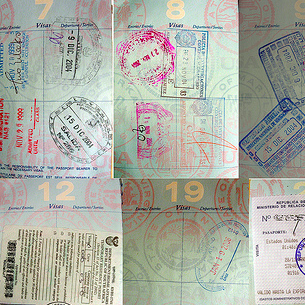

How to Get a Duplicate U.S. Passport

This post is relevant for readers with U.S. passports who travel frequently. If you don’t fit in that group, feel free to skip this one – or just read it for the entertainment value.
I’ve mentioned a few times that I have two U.S. passports, and each time at least one person asks me how that works. Well, I’ll you exactly how I got the second passport, and what you need to do if this would help you as well.
First, the need for a second passport. Why bother?
U.S. passports are good for a number of reasons: notably, they are valid for 10 years, and when you fill up the pages with lots of stamps and visas, the State Department in Washington, D.C. or any embassy abroad will issue more pages at no charge. I’ve had three passport page extensions so far, and without that option I would have needed at least four passports by this point. No other major country that I am aware of offers a passport that includes both of these important features.
As good as a U.S. passport can be, there are still two problems with having only one passport of any kind. First, when you visit politically sensitive countries (especially in the Middle East), the ensuing stamps can cause delays and other problems for you later.
When I recently came back to the states via Miami, for example, the immigration officer had a least a dozen questions for me as he flipped through the passport. Among other things, he asked me:
Why did you go to Pakistan?
How many days were you there?
Who did you meet with?
Who paid you to go to Karachi?
The irony here is that my trip to Pakistan was a while back, and when I returned to the U.S. at the time, I was waved through without any questions at all. This goes to show that when it comes to immigration, you never really know what’s going to happen until you approach the desk.
I should also mention that the questions are not always confrontational. Many immigration officers are impressed with so many passport pages and stamps, and several have even congratulated me. However, the occasional interrogation is enough to cause me concern, especially when I’m far away from home and relying on the mercies of an unfamiliar country.
Second, as I go further and further throughout the world, I frequently need to arrange some of my visas in advance by applying within the U.S. Some countries do not offer visas on arrival or allow travelers to apply from a third country, and if my passport is in the hands of a consular officer for weeks, then obviously I can’t go anywhere until I get it back.
Thus, the problem: to travel to fun places, you need visas, which require you to send off your passport for a variable length of time. While your passport is sitting somewhere, of course, you can’t go anywhere else. This makes travel hacking and advanced travel planning difficult.
How to Fix the Problem
The U.S. government allows independent travelers to obtain a duplicate (i.e., secondary) passport as long as you can demonstrate a need for it. Specially, you need to:
1. Fill out an application
This is easy. The application is here.
2. Decide if you want to use a service company
You can do this on your own and save at least $50. I used a service company (A Briggs) mostly because it looked easier to me. I’m not a journalist, so I wasn’t sure if the State Department would reject my application if I sent it in myself. The company was actually quite helpful, so in this case I’m glad I spent the extra money.
3. Write a letter explaining your need for a second passport
You need to write a one-paragraph letter explaining why you need two passports. It helps if you can include an upcoming itinerary to sensitive countries, or at least a record of frequent international travel in the past.
4. Submit the application and the fees
The cost is US $135 plus whatever fee is charged by the service provider if you use one. Also, note that the second passport is only valid for two years. Unfortunately, you can’t get a second 10-year passport.
Having the second passport has already helped me several times, by being able to send off the new one to random embassies (Russia, Eritrea, etc.) with no real worries since I have another one safely in my office.
In fact, while the increased travel freedom is good, the greatest benefit of having two passports is peace of mind. I don’t have a lot of “treasured possessions” – I value experiences much more than physical things — but if forced to pick something, I’d reach for my 100-country passport. Have you seen all the stamps?
Wrap-Up
As mentioned in the beginning, most people need only one passport. But if you’re adventurous, this may be what you need. If not, at least you know how it works.
###






31 Comments
I’m not a US citizen, but I still find this article interesting 😉
In fact, I have dual citizenship. Irish (by birth) and British (from my father). There is no advantage to having a British passport over an Irish one, but I applied last year and it has simplified my travels in so many ways. I’m going to India shortly, but sending off one passport for a visa did not prevent me from travelling to Germany for New Year’s with the other!
Apart from what you mentioned, having a second passport came in handy when I lost one of them when I arrived in Argentina a few months back. I still needed proper ID to get a SIM card for my mobile phone, proof of identity to be given the apartment etc. and that would have been much more complicated if I had just one passport, which was then lost.
As well as this, my Irish passport was issued in 2001 before biometric pages were required. EU citizens don’t need a visa to get into the states, unless their passport doesn’t have this page. Without my second (brand new) passport I would have had to cancel my Irish one and apply for a new one or spend money and post off my Irish passport to the US embassy, and of course wait plenty…
Also, like you said once before, having two passports has a real James Bond feel to it 😛
Chris –
My 2nd passport, which I applied for in August, has an expiration date of two years rather than ten. Is this still the case? Since some countries require one’s passport to be valid for up to 6 months after the Visa issue, make sure your second passport fits that range!
I have two passports: British and Australian. It is useful to have more than one.
@Alan,
Yep, that is still the case! The replacement passport is just for two years at a time.
Recently I’ve heard something about passport cards. How do these play into the usefulness of a passport book/applying for visas and stuff, or are they really only good for ID kinds of use?
Dual passports (ie holding passports of 2 or more countries) can be even better. Of course you have to qualify and there are some special rules to be aware of if you have dual passports.
Anyway, I wish my country allowed duplicate passports. I’ve already had to can a planned trip to Bhutan due to difficulties in getting a visa in a short international-travel-free period. I’m finding each year as I get to visit more tricky countries, that scheduling my travel is harder and harder. In 2008 I set aside 3 non-international travel periods each of about 3 weeks to arrange visas. Without those breaks I would have been stuck. In my own quest to visit every country, I’ve almost run out of countries that have local representation through which I can apply for visas – thus I will have to allow even more time to arrange through a third country. I expect this means the 23 new countries visited in 2008 will not be matched or even close to it in future years.
As for questions about Pakistan – I got that too on my second trip home after visiting there. They wanted to know if I’d visited any terrorist training camps!
My second passport is a Romanian one, so I guess that might do the trick whenever I start traveling to visa-necessary nations. I’m looking forward to when Romania’s EU probationary period ends so I can be an EU citizen with all the frills (whatever they might be).
South Africans can, for an extra fee, apply for a maxi passport with double the number of pages. This will allow one double the amount of travel before the passport has to be renewed just because it is full.
You can also get a wallet-sized passport card if most of your travel in on the and and sea borders or Canada, Mexico, and the Caribbean. It’s cheap and convenient.
I have a French passport and it offers both of the important features you refer to (extension pages and 10 years validity).
Now I can apply (dual citizenship) for a Canadian passport, but unfortunatly it’s only valid for 5 years…
@Anca,
Yep, that will definitely help!
@Global Traveller,
Terrorist training camps – hilarious! I’ve yet to hear that question, but I’ll be prepared if it comes up.
@Ashley,
In the U.S., the new passport cards are fairly limited — as you note, they are mostly like a form of ID rather than an international travel document. I believe they are for people who only need to go to Canada and Mexico.
@Niel,
Good point. I think most of my South African traveling friends paid for the thicker passport, and it’s been a good investment for them.
@Julien,
That’s great – I did not realize French passports offered both of those features. I don’t think that is true across the EU, but I’m not 100% sure.
Just curious if you know about this too. Since you were flying into Miami, I’m imagining you may be somewhat familiar with the local population. So here it is: Do you know how to get a duplicate green card? I’m cururious because a Cuban friend of mind, born in the US in 1971, lost his card and he doesn’t have much money. US rules supposedly say that since he was born in the US in 1971, he can basically automatically become a US citizen. But, as I said, he lost his card. As far as we’ve been able to figure out, it costs a fortune to get that card replaced which one has to show in order to gain full citizenship. And, worse, it then costs and even bigger fortune to get the citizenship thing. Know any cost-saving methods?
hi, thank you for the information. but a two-year only duplicate passport won’t do me any good since i’m an airline crew member and certain countries require a at least two and half year passport to issue a multipul entry crew visa. so i’m just thinking to claim i’ve lost my original passport and ask for a new one. this way, the second one should be good for 10 years also, right? can i do this?(i know i have to lie, but it seems the only way to get a 10 year duplicate passport.)
thanks for your comment
david
Chris
Helpful, thanks for sharing. Maybe you can help me out. Here’s my story- the short version. 🙂
Both my parents were born in the U.S. but I was born in Canada. Only spent two to three weeks there. I tried to get my U.S passport and it was denied because they wanted my mother’s passport at the time, we didn’t have it.
Now we have it so it should work. Is dual citizenship attainable given my situation? I’m a naturalized U.S. citizen. Do I need something that says that?
Thanks in advance for the help.
-Miguel
Chris,
Are you sure about the $135 fee? A U.S. passport by mail is $75 (I’ve linked to the page above). Possibly you’re quoting the fee your service charged? Or did you add an additional $60 to have the passport expedited?
Take care,
Mike
@Mike,
I’m not 100% sure, but I believe the fee is higher for a second passport. The link you mention shows only the fees for the first (regular) passport.
Dear Chris,
Great post, and very helpful, as we faced the exact scenario you describe — having to send a passort away to get a visa, but needing that same passport for immediate overseas travel.
However, you risk confusing people by using the words “duplicate,” “replacement” and “second” more or less interchangeably. If my research is correct, one applies for a duplicate passport — an exact copy — when the original is lost or stolen. What you are talking about here is truly a second, *different* passport, which exists alongside your original.
Thanks and best wishes,
Stuart C.
Speaking of passport cards, they are only like an ID since they are only useful the land and sea borders of the US. That said, travelers would be wise to pick up one up. They are only $20 if you currently have a passport. With it, you get a nice card sized ID that serves as the perfect photo id. If you ever lose your passport when traveling, having a passport card will greatly speed up any replacement procedures.
Chris, Just wanted to give you a quick thanks for being so helpful. Your article let me know about duplicate passports; I’d never heard of them before. I just got mine back from the State Dept (I didn’t use a passport service for this). And the State Dept actually made a mistake in my favor! They sent me a brand new 10-year passport as a duplicate passport…and they didn’t cancel my old passport! Too bad they didn’t make the same mistake on my wife’s duplicate passport and she only got a 2-year one…
@David
I would think, though I’m not certain, that if the State Dept issued you a new passport to replace a “lost” one, they would almost certainly cancel the first one issued to you, making the whole exercise neutral at best. I don’t think you’d have any chance of winding up with 2 passports by telling them you lost one.
I had no idea about the duplicate passport option! When your 10 year passport expires, do you apply in person for a new passport rather than give back your passport as seems to be required when renewing online?
I’ve been struggling with whether I want to send mine off with the online renewal or or not!?#!
I am assuming that you are using the larger US Passport that comes with extra pages?? It doesn’t cost extra, is much sturdier and provides quite a few more pages. I can’t remember exactly how many more but I think it’s close to double the number of pages that are in a standard US Passport.
I went to that on my last renewal and am very glad that I did. My last one was looking pretty shabby, this one is much tougher than the standard. Plus, it will certainly take much longer before I need to add pages!
This is fascinating. Let me ask, is the duplicate passport marked as “duplicate passport” and/or does it contain other markings letting U.S. and foreign immigration people know that it is a duplicate, and doesn’t that freak them out and cause them to ask more questions about why you have a duplicate?
If it’s only good for two years, wouldn’t the fact that it was issued in 2009 and expires in 2011 be a red flag to immigration officers that it’s a duplicate? Does it otherwise look just like a regular passport?
I would imagine that if you’re “caught” traveling in some third world countries with both passports on you, it could be problematic.
Anyway, this is great to know about. Thanks.
I’ve got dual Finnish-US nationality, and going to Brazil with my Finnish passport saved me the $50 bill my other America friends would have to spend on a visa… woo!
“Recently I’ve heard something about passport cards. How do these play into the usefulness of a passport book/applying for visas and stuff, or are they really only good for ID kinds of use?”
The Passport Card is especially useful to us people who live on or near the border. It’s the size of a credit card and you can always carry it with you. And yeah, it’s cheaper too.
However, the Card also has an added benefit to me. I too have a Passport book with tons of stamps (not as many or diverse as Chris’). Each time I pass through US Immigration, by showing them the Passport Card, I don’t have to show them my Passport book with all its stamps. If the officer gets too curious or suspicious about the stamps, he will start asking me so many questions. One time (before I made the decision to get the card), an officer flipped through my book’s pages, and said “wow, you have a lot of stamps….you even have extra pages… how do you pay for all this traveling? What do you do for a living?”. I fully detest such interrogations (even though I have nothing to hide). Based on that experience, I decided I needed a Passport Card when entering by land. So, with the Card, they won’t ever have to see my Passport book pages. I guess they’re very sensitive to drug trafficking and smugglers going across borders. (I get the impression that CBP officers at the border are more aggresive than their colleagues at the international terminals at airports. So far all of my US international arrivals at airports have been very smooth in regards to CBP officers, with very little to no questioning.
Chris-
I’ll be studying abroad in Amman, Jordan, next year, and have heard that trying to have Jordanian, Israeli, Syrian, and Egyptian stamps can make life hard. Is this the kind of good reason that would suffice? Also- could you expound on the service company you used? What exactly did they do? (Yeah, yeah, it’s kind of cheap, but I’m a student and would rather not spend $50 on something I could do myself…)
Elise
@Elise,
It’s just the Israeli stamp that is problematic. If you have that one, you won’t be able to go to Syria or a number of other countries (Jordan and Egypt are OK). Yes, that’s a sufficient reason and they are used to that. The service company did everything for me in terms of the actual application– and yes, I think you could do it for yourself if you had the time. Happy travels.
Elise – you can ask the Israelis not to stamp your passport – they have an exit visa piece of paper to show you entered legally when exiting and they just stamp that. I heard that works. I’ve never done that because I have two passports (British and Australian) and have no intention of going to Syria. I used to live in Israel and a lot of my family does now. I have been to Tunisia and flew from there to Tel Aviv with no problems (via Frankfurt but my luggage was forwarded on to Tel Aviv).
I have a Swiss and a Canadian passport and i always have both of them with me, but i use the one with wich is easyer to enter a country…))) Not to much questions, visas or whatever. Helped me already several times…
Your comments are welcome! Please be nice and use your real name.
If you have a website, include it in the website field (not in the text of the comment).
Want to see your photo in the comments? Visit Gravatar.com to get one.