
Before and After
In 2004 I went to Liberia for the first of five visits. It was a pretty crazy place at the time, having just ended an 14-year series of civil wars a few months before I arrived with a small assessment team. The streets were patrolled by U.N. tanks, the only electricity was provided by private generators, and the non-functioning lampposts were covered in bullet holes.
While surveying villages outside of the capital Monrovia, we found this site where villagers obtained their drinking water.
As a traveler, I drink the tap water almost everywhere I go — but you can be sure I brought my own $3 bottle of water with me that day. No one builds up an immunity to a water source like that.
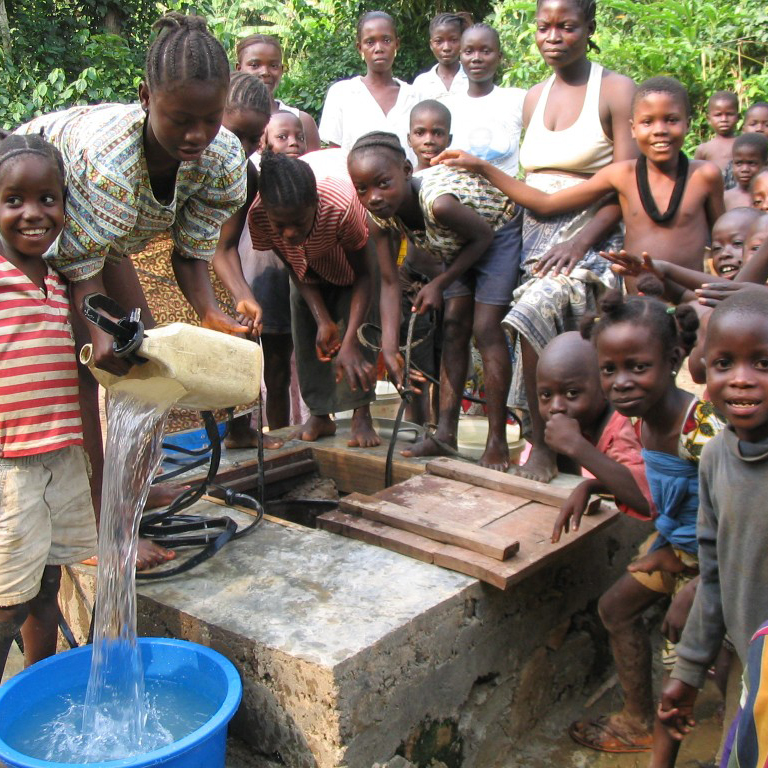
The previous year, while working in Sierra Leone, we had taken up a collection for another charity further upcountry in Liberia. After seeing the first water source, we made our way to the second site in a long, bumpy ride in a Land Rover. A crowd gathered to greet us, and this was the image we found at that scene:

At this site we heard a number of interesting things from the villagers, the most interesting of which was that no child had died since the well had been installed. I thought that was a pretty good return-on-investment: pay for a well, work with a local organization to ensure a strong educational campaign accompanies the arrival of the well, and children stop dying.
Stories like these are the best way I know to illustrate two things:
1) The global water crisis is staggering. I won’t bore you with statistics, except to note that almost one billion people in the developing world are more likely to drink from a water source like the first image than the second.
I don’t know about you, but these days I’m more concerned with the quality of my cappuccino than my drinking water. Despite the fact that the world is unfair in many ways, I find it unacceptable that so many people have to worry about where their daily water comes from.
2) Enabling people with the ability to make their own choices is the best form of development. If you can’t make the simple choice to not get sick all the time or keep your children alive, your options are very limited. There isn’t much “lifestyle design” in places like this.
Having been through graduate school in the social sciences, I’m well aware of the moral relativist argument that we should mind our own business and leave these things alone. But fortunately, my two years at the university were preceded by four years in places like Liberia and Sierra Leone. I’ve seen too many water sources like that of the first image, and no one wants their children to die before the age of five due to a completely preventable illness.
Next week, we’ll kick off the new AONC Charity Project. It’s actually not completely new; I’ve been donating a big chunk of revenue towards it for a while, and I’m working with my publisher to integrate the project with the book that comes out this fall.
I haven’t said much about it before and don’t want to make a public issue about my own giving, but I also realize we can do a lot more as a group than any of us could on our own. Therefore, stay tuned for a different kind of launch, which will be accompanied by an ambitious goal (of course).
The thing about before and after — it’s hard to go back to before when you’ve experienced the after. This is true in life, clean drinking water, and transformation of all kinds.
###
You can follow me on Twitter here
You can join AONC on Facebook here
Photos by Scott



52 Comments
I’m so glad you’re bringing attention to this issue. I agree – it’s a huge problem in the developing world and is completely unacceptable. I look forward to reading more about the new charity project next week!
“Enabling people with the ability to make their own choices is the best form of development.”
You hit the nail on head with that one, Chris. Looking forward to getting involved in your Charity project!
Living in the NW of the USA, it’s hard to imagine having a water problem, but I know just how incredibly pressing of an issue it is for much of the rest of the world.
I’m interested to see what’s in store for this charity project as one of my goals for this year is to do a better job of targeting my charitable giving and getting more involved in the organizations I give to.
I’m glad you’re doing a charity project. I look forward to helping out.
I can’t imagine seeing the things you’ve seen, Chris. But I can imagine the difference you’re making by shining a light on them. Thanks.
Living in the Eastern Caribbean, for the first time I’m starting to really have it dawn on me, the reality that might be if – or according to seismologists, when, we get hit by a quake the size of the one just experiences in Haiti. I don’t know if it’s seeing it so close to my home, or the sheer scale of this tragedy on top of Haiti’s history, but it really has touched concerns for preparedness of family and friends – I’ve been trying to put together some resource lists to share with survival ideas and ways in which to purify water is one of the main things I’d like to have, so if anyone has links to sites that provide personal or small water purification systems or gadgets – the kind that people on small budgets could reasonably afford, please do share!
Great post Chris. This is an issue I feel like is finally starting to get the attention it deserves. It’s so easy to take something so simple for granted living in a developed country. Thank you for helping raise awareness.
Awesome stuff. Water is the foundation of life. In China, I don’t drink the tap water. It’s not due to bugs, but due to metals in the water that I won’t. Living abroad has made me appreciate more being able to drink from the tap at home.
Chris – This will be great! Your charity project will be larger than life! The best part is I know that if your readers/ community get involved, we will get updates and real insight into the project’s deliverables. Your transparency and approachability will really help in this arena!
Mobilizing your Small Army. Excellent!
This is Big Picture thinking.
I’m so glad that you are taking action on the issue of drinking water and publishing it so that others can pitch in and help.
Reading about things and actually experiencing them is very different. What has been seen cannot be unseen.
I am glad that you found a cause you are passionate for! I’d love to help out when I can.
Chris, I’m excited about this (not-so)-new direction of your projects… this is an excellent article that makes a point with simple, sharp images. It’s especially interesting to think about development/aid in light of the response to Haiti’s earthquake… I think it’s very important for these conversations to be held in a public forum.
Thanks 🙂
I commend you, Chris, and all those who have commented on your thoughts and feelings. I’d like to add that while the vast majority in the U.S. have adequate potable water at our kitchen sinks, there are still many in our country who lack decent water, food, clothing and shelter. When I moved to the Washington, DC area in 1970 and to the Annapolis, MD area in ’74, I found places within 7 miles of the DC border where there was no running water or indoor plumbing. They at least had wells, that I hope provided good water. I’ve spent most of my adult life drinking deep well water because of the places I’ve chosen to live. But, throughout Appalachia and other poverty stricken areas of our country, on many, if not most of the Native American Reservations we can find acute needs and, believe it or not, even in our large cities there are children going without many of these basic needs. So, my point is, there is also much we can also do right here in our own backyards. Keep it Rolling!
Let us know if you would like to come to Copenhagen we would love for you to talk about your charity to our sponsors. And we would love to re-publish some of your articles and photos, especially this one. Maybe we can find a way to support your charity more.
Thanks for this post Chris. This is a subject that I dealt with extensively in my own master work. I got to learn about the development side as well as the engineering aspect of well installation and management.
It is horrible that so many people can’t get safe water to drink, and even worse that they can’t get it for their children.
I have been trying to find ways to help in this area, and am very excited about the upcoming project. I will definitely be signing up in whatever way possible to help it move forward.
Thanks!
“Enabling people with the ability to make their own choices is the best form of development.”
This is a perfect and beautiful articulation, and my new mantra. Thank you, Chris, for continuing to open my eyes.
I was worried at first that this post would be pushing some sort of weight loss plan, so thank you for putting my fears to rest.
And I could not agree more with your assertion that “The thing about before and after — it’s hard to go back to before when you’ve experienced the after”, but would place even more emphasis on how it truly is the “experience” that gets you to the “after.” Reading a news article while sitting in relative comfort here in the US will probably not have the same effect as working in Liberia (in your case) alongside those in need of clean water.
That whole “walk a mile in another man’s shoes” thing.
The first image reminds me of the water sources I’ve seen in villages here in Cambodia. An interesting problem some of these villages face is that NGO’s are quick to come in and install a well without doing their due diligence – without talking to the villagers or surveying the grounds. One village in particular has a number of wells that weren’t dug deep and has switched back to using the water from hand-dug ponds that look like your first image.
I’ve been thinking a lot about the interview here a little bit ago with the aid worker in Darfur. The statement that resonated the most and keeps coming back is how her job is to listen. If the NGO that installed the wells in the village had listened, they would have known to dig deeper.
Listen is the mantra I repeat to myself when I’m particularly frustrated. Living in a developing country, not knowing the language, but wanting desperately to help can be incredibly challenging. However, the possible rewards are even greater.
Unbelievable isnt it. There is some good work being done in the UK on this, but there is always, always room for more action. Thanks for the reminder.
Three trips to Sierra Leone have radically altered my perspective on the world, so I can relate with your post about your time in Liberia. I am thankful that you are about to leverage your social influence for the sake of people who need clean drinking water. Your efforts will be multiplied!
thanks, chris, for a continuous stream of inspiring examples. the very essence of consciously designing one’s life, to me, is to free oneself as much as possible from the demanding distractions of cultural expectations, so that we have more opportunity to see the wells, meet the people, and do some good (and have a lot of fun while we’re at it!). while a great cappuccino is perhaps an indulgence, you’ve given the world an example as to how those of us with resources can decide to orient our lives towards greater mobility, less consumption, and therefore more meaningful participation in life. i’d say don’t sweat it too much! looking forward to more…
Kudos! A friend of mine, Elizabeth Beech, combined her love of U2 and helping our global human family many years ago and started the African Well Fund. They do an annual fundraiser in honor of Bono’s bday and have paid for the construction of 10,000 wells (so far! More to come) in Africa . Volunteers can also plan trips to help communities build the wells.
She is complete awesome sauce. Works full-time but managed to start this little volunteer-run non-profit in her free time that has saved thousands of lives. Water is life, after all. Congrats and thanks on using your celebrity in such a powerful way!
Thank you so much for sharing your awareness. You’ve brilliantly and simply illustrated a huge problem and a clear solution. I’m also grateful for the reminder of how fortune I and (I wager to say) most of your readers are in ways that we take for granted. I look forward to learning more about your Charity Project and doing what I can to help.
After working in Haiti for 2 years and seeing even worse before’s than you showed, I am glad to hear more people talking about this issue. Until a population has the very basics for life – food, clean water & shelter, they cannot address the poverty they live in.
I look forward to hearing more about your project. The more of us working toward basic human needs for everyone, the better off the planet will be. Thanks
Thanks Chris for bringing this up. Truly the western world doesn’t understand the magnitude of this problem. The second picture brings back memories of fetching water from the well when I was in high school in Nigeria. I also remember the panic I felt after days of no water coming out of our taps in Nigeria when my children were still small. America has been enjoying for a long time, but I hear that in many areas, even here it’s going to get hard in terms of clean, safe water. We really don’t know if what we’re drinking now is safe.
Thanks for your work done. It’s easy for us who have been away from Africa for a long time to forget and this is a reminder.
Thank-you for shedding light on this particular issue AND thank-you for showing how bloggers can make a difference by raising awareness, motivating readers to act and (I’m anticipating here) facilitating action. Great post.
Hey, Chris, great topic. I just want to point out that we have this same problem in our own Hemisphere. I’ve been involved with Haiti since 1984 when I lived there for 2 years. I’ve gone back 10 times over the past 12 years with a rehab organization, Healing Hands for Haiti Foundation as a translator for docs and nurses going there. Haiti has similar issues and it’s in our own back yard. I know that many people are acutely aware of the issues in Haiti, thanks to CNN, but I wanted to state it in regards to your water topic. Kimbe firm!
i was not expecting this post. really mobilizing without meaning to be. count me in.
Water crises are one of those problems we hear about, but rarely actually see. Thanks for posting those pictures; what a wake-up call. Can’t wait to find out more about (and hopefully get involved with) your Charity Project.
Bring it! I’d be glad to help you. It’s kind of one of those unsexy issues that needs more attention. I think charity:water has definitely helped with the cause though.
This especially resonates with me now, having 4 young kids. I too am all for tap, but I’m definitely more conscious about water supply in developing nations now that I want to start taking them along for the ride. My 1 year old enjoys drinking the old bath water every now and then. We take so much for granted.
Can’t wait for $100 biz school next month. Congrats on the quick sell-out! I’m not surprised. I’ve been putting off starting a business pretty much since my first child was born. I’ve taken in lots of info, but have been slow to pull the trigger on anything major. Too many excuses…family, full time job, trying to pick the right niche, etc. If nothing else, I hope it will bring some accountability. I’ve followed you both for the past year and have a good feeling about this.
Launch on brother!
This is one of the most important posts you have ever written. I really appreciate, as other commenter’s have said too, your shining a light on such an essential NEED.
Wow. I’ve realized that this is one of those world issues that I am guilty of not knowing much about. Sure, I’ve heard about lack of clean drinking water, but have never seen it first hand. So I’m guilty of taking my daily clean tap water for granted. Thanks for the awareness and I’m looking forward to this charity project…
thanks for so the vivid, profound images and message. i look forward to involving myself in your latest venture. as a social worker, i really appreciate the attention and eloquence that you bring to your endeavors.
Just amazing, Chris, to see how all of this is developing around you — it’s all about authenticity and trust that you exude in everything you do.
And on the Charity/Water front, you might want to check out Jack Sim at WTO (that’s World TOILET Organisation) and also the magic of ’embedded gratitude’ and transaction-based giving at the heart of Buy1GIVE1 — B1G1.
Be sure to keep on doing …..
….. things that amaze you (and us).
Paul
I really enjoyed reading your experiences, it reminds us in the world we live in today where we do take our water for granted, our daily bathing, our clean clothes, the vegetables we eat need water to grow, the clean sea we swim in, purchasing clean cool water in a bottle and the list goes on. I look forward to hearing more about your project and how we all can jump on board and help you in one way or another to help others less fortunate than ourselves.
Everyday this will remind me of how fortunate i am, and it will remind me that together we can lend a hand to make a difference.
Thank-you
Excellent! So the next question: what were the toilet facilities like?
Chris,
“It’s hard to go back to BEFORE when you’ve experienced the AFTER”
That was a highlight for me; a very timely word. Thanks for your inspiration.
Chris – have you seen the documentary “Blue Gold: World Water Wars”? I watched it recently on Netflix and was blown away by the magnitude of this problem I had never heard much about. My impression from watching this film is that the magnitude of the problem is as great as global warming. In addition to discussing the access problem you illustrate, they also talk extensively about the privatization of water – from the industrial world to the developing world. How in parts of Africa Coke sells Coca Cola to the local community cheaper than they sell them water (Dasani). It was an eye-opening film – I would recommend it to anyone who wants to educate themselves on this issue.
hi! im very happy to read about your work! Is there a way that i can help contribute? I can contribute in terms of graphic design publicity. Thank you!
I was just shaking my head at myself for leaving the tap running as I filled up my water bottle in preparation for a day at my desk. Shaking my head a) from shame as I had let the bottle overflow and was being wasteful and b) from recognizing my tremendous good fortune to be able to take water for granted. And then I read this. Now I’m shaking my head in amazement about how folks like you really step up. Am getting a headache from all this head shaking.
I’ll look forward to reading more and getting involved. Thank you.
Chris – I wrote a recent post on my blog about things that tick me off on a daily basis, but after reading this I feel slightly ashamed to be bitching about stuff when I can at least get clean water from a tap.
Why do we waste so much when some people have so little?
Good luck Chris with the project
This is my favorite post you’ve ever posted, Chris. Very inspirational. And it feels like a good reason for doing the sort of travel you do. More like this please.
Count me in Chris – Looking forwards to hearing more about your project in later posts.
When you have your 50 state tour, I hope you will stop by Charleston, SC and check out Water Missions International.
Thanks for raising our awareness to this crisis.
This comment is unrelated to this post…just wanted to write that thanks to your Frequent Flyer Master program, my American Airlines account is up to 30,000 miles in about two months! I’m a believer!
Related to the post: I look forward to the charity website.
Very Good. This issue is a finite issue that results can be measured accurately, and the solutions sure and immediate.
The problem with a lot of the current “climate change” proposed problems and proposed solutions (i.e. Cap and Trade etc) is that things are so ambiguous that real results and real solutions cannot be quantified and it is unknown even if the “solutions” are correcting the perceived problem.
This issue is real, and can be approached with out politics getting in the way. Correcting this problem and helping with the solutions is something I can firmly stand behind. Bad water isn’t just a theory based on shaky evidence – it is easily defined, and can be correct.
Providing clean water in those area which have none is a real solution to a real problem. Bravo on this report and proposed solutions.
Thank you for the straightforward description of the water situation. I copied as much as I could, credited you, and will share it with my school’s 6th graders. They are catching grief for raising funds for Water for Africa instead of Haiti. These are very compassionate kids, and they will appreciate seeing your photos and hearing the true story.
Thanks again.
Based on the Bitcoin trouble ranking, the
largest leap ever (300% at block 68544) took place many nights after the story
on Slashdot that variation 0.3 of bitcoind was discharge which introduced lots of fresh
adopters and miners.
My weblog: http://www.facebook.Com
The overall goal of this study was to research the effect of economic management practices on the standard of accountability within the churches in Nairobi.
Your comments are welcome! Please be nice and use your real name.
If you have a website, include it in the website field (not in the text of the comment).
Want to see your photo in the comments? Visit Gravatar.com to get one.