
48 Hours in Northern Iraq

Hello everyone, here are the details behind my secret stopover while on the Baltics and Beyond trip. I had a stop on this part of the trip that I deliberately chose not to publicize in advance. The secrecy was partly for safety concerns, but just as much because I wasn’t sure it would work out.
Breaking off from my exploration of the Baltics and Eastern Europe, I traveled to the Kurdish region of northern Iraq last weekend. Yes, I made it there and made it back with no problems, and with even more of an appreciation for how people live their lives with profound optimism in the midst of all kinds of trying circumstances.
I was worried about how I would be able to take Iraq off the list, but now I can say with integrity that I’ve done it. Here is the whole story, but first…
A Quick Geography Lesson
Kurdistan is not Kyrgyzstan or Kazakhstan (you know, where Borat is from). It is a northern region of Iraq that was occupied and repeatedly attacked by Saddam Hussein prior to his demise. Unlike the rest of Iraq since then, Kurdistan has been peaceful and largely unaffected by the sectarian violence in the rest of the country.

Even though they live within the political borders of Iraq, the Kurdish people have their own identity. For the most part, they don’t really want anything to do with the “other” Iraqis who live in Baghdad, Mosul, and the rest of the country. They fly their own flag, speak their own language, and pretty much do their own thing.
In other words, Iraqi Kurdistan probably should be a sovereign, independent country, but because of how politics works, it is instead a semi-autonomous region that is still accountable to the Iraqi government.
OK, that’s the geography. And now, on to the trip!
A funny thing happened to me on the way to Kurdistan. The leading political party sent me a personalized welcome message.
A couple of weeks ago, I wrote to the Kurdish Democratic Party to ask about the visa situation. Most of what I read indicated that I could get a visa on arrival at the airport, but a couple of conflicting reports said that it had to be arranged in advance. I wasn’t sure the Kurdish Democrats would even reply, but they did so within 24 hours, telling me that it would be no problem at all to receive a visa on arrival.
Not only that, but they had also gone to my web site (thanks to Google, I presume, since I didn’t include an email signature with my message) and copied my photo into the reply, along with a nice welcome message that read:
“WELCOME CHRIS GUILLEBEAU TO KURDISTAN!”
I was pretty amazed at that. Thanks, guys. You definitely have my endorsement for whatever political platform you’re running on. Feel free to use my name and image in your campaign posters.
The welcome message set me at ease for what I was otherwise a bit nervous about, because even though I knew it was peaceful, after all, it is still IRAQ. Most people do not just fly in over there for a couple of days of independent touring.
But that’s exactly what I did, and it worked out even better than expected.
I arrived at Erbil International Airport (EBL) and was impressed with the facilities from the beginning. The immigration guy stamped my passport right away, and didn’t say anything about a visa. The customs officers (all women) waived me through with a smile.
On the other side of arrivals, I was given a free map of Kurdistan (I noted that the word Iraq was nowhere on the map), and helped to a taxi outside the door.
One company has a monopoly on taxi service at the airport, and they have the great name of “Hello! Taxi Company.” They told me it was a fixed rate of $25 to the city, which sounded high since I knew it wasn’t far away. There is another option to take a bus to a security checkpoint and then negotiate with a street taxi from there, but since I had never been there before, I decided to play it safe and take the Hello! taxi.
The taxi was a brand-new LandCruiser that reminded me a lot of my years in post-war African countries. It was 90°F outside, but as soon as the driver fired up the engine, a huge blast of air conditioning immediately cooled the vehicle. The driver got on the shortwave radio to tell his base about my drop-off, and off we went.
After riding for less than fifteen minutes, I told the driver to let me out at a small, two-star hotel called Shahan, where I booked a room for $23 a night. (I thought it was funny that the room cost $23 and the taxi to get there cost $25.)
I could have stayed in any number of cheaper places down the street, but I decided that $23 was a fair price for my own room. Besides, every hotel I had read about on the internet was for military contractors and U.N. people, and they charged $200 a night.


Photos (click to enlarge): Snacks and juice; cool statue; icons for sale
I spent the afternoon, evening, and most of the next day wandering around the city on foot. I never once felt unsafe or hassled in any way. I bought some almonds and cashews for a light dinner, which I had back in my room at the Shahan.
I visited the NasDak (I think it’s supposed to be like Nasdaq) shopping center, which still has a way to go before becoming a Dubai-style mall. The NasDak has five floors, but only the middle two have any shops in them, giving it the vibe of a downtown mall that has seen better years.
Just like most developing countries, fake DVD shops were in full abundance, selling collections of Angelina Jolie “master sets” and the latest blockbusters from both Hollywood and Bollywood for $2 each.
Walking around the citadel at the top of the city on my second morning, I met a soldier who came over to chat. It was a short conversation, since we had no common language. In situations like this, I’ve learned through many such exchanges, smiles and handshakes go a long way. He pointed to my camera and for a moment I worried that I was in trouble, but it turned out he just wanted his picture taken.
I was happy to oblige:

Interesting Notes
Erbil is truly a place on the rise. The kingdom of the Golden Arches hasn’t made it here yet, but with impressive infrastructure going up all over the city (and the whole region, or so I hear), it’s clear that the Kurds have big plans. My guess is that more development will come to Kurdistan than anywhere in Iraq proper.
The comparison to a U.N. republic ended at the airport. In the rest of the city, I saw plenty of Kurdish policemen and a few Kurdish soldiers (like my citadel friend above), but almost no international peacekeepers. A small force of South Korean U.N. soldiers is bunkered down with a Kurdish force somewhere outside the city, but the local joke is that the Kurds are there to make sure nothing bad happens to the Koreans.
***
For my evening reading, I picked up a copy of The Kurdish Globe, an English-language paper published “from the heart of Kurdistan region.” Readers of my recent essay on patriotism may be interested to know that Kurdistan, of all places, is planning to abolish the death penalty sometime next year.
By the way, for those of you who asked if I am going to start writing about U.S. politics, my answer is “not really.” My writing is non-partisan and I have friends of all political backgrounds. I am far more interested in writing about the whole world, and how remarkable people can achieve their own highly significant goals.
But if a semi-autonomous region in the Middle East can make plans to abolish the death penalty while America continues to put prisoners to death every year, I think it’s valid to question which place really understands criminal justice. To provide fair and balanced reporting, I should note that the same paper discussing the abolishment of the death penalty also has an article praising the fine sport of cockfighting, which takes place six days a week in Erbil for a $1 cover charge. My favorite sentence in the article was, “For those involved in rooster fighting, it’s not just the battles that attract them to the sport. They also admire the beauty and height of the special roosters.”
I’m not a big fan of cockfighting, but I thought that description was hilarious.


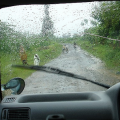
Photos (click to enlarge): Cool road sign with directions to Baghdad and Mosul; taxi roundabout in central Erbil; Erbil Int’l Airport
Getting to Erbil (and getting back)
Perhaps it’s obvious to say that this kind of travel is not really for beginners. Virtually everyone else on the flight from Vienna was Kurdish or with some kind of military group. The ticket usually costs more than $1,000 for a three-hour flight. Thankfully it cost me only about $320, since I used it as part of my first Round-the-World trip that I paid for more than a year ago.
(Side note: I know that a lot of you—several emails a day, on average—want to know more about how I’m able to travel to places like this for so little money. I promise to provide the full, unedited details soon for those who are interested.)
Even though it’s perfectly safe, there is not a whole lot to do in Erbil besides visit the NasDak and check out the fake DVD shops. I hear the Kurdish region beyond the city is probably worth exploring more, but since this was my first trip to this part of the world, I wanted to stick with Erbil and make sure I was comfortable. It was definitely worth it!
On the return trip to the airport, I made my own taxi arrangements. As I suspected, this was a much better option. I offered the driver $5 to take me, and he immediately agreed — which meant I probably could have paid less. Having paid $25 to go the other way a couple of days prior, I was happy with the $5 fare. At the drop-off point, I gave him a dollar tip and walked to the first security check-point, located about half a mile from the terminal.
Three times in a row, beginning at the first check-point, continuing to the one in front of the terminal, and finally at the one in front of the gate, all passengers go through a full security routine: belt off, watch off, laptop in case, mandatory pat-down, etc. At the third and final one, two contracted security agents searched through my bag by hand. They confiscated the batteries from my electric razor (disposable batteries are not allowed on the flight for some reason) and tried to take my contact solution, but relented when I protested about that.
The airport itself is a bit sparse, but isn’t bad otherwise. I was pleased to find out that they had free wi-fi, something my home airport in Seattle doesn’t provide. I waited two hours until the Austrian Airlines jet landed on the huge runway, discharged its passengers, and welcomed the half-filled planeload of those of us returning to Vienna. We took off right away, and I said goodbye to the land of the Kurds.
***
Now that I’m back in Austria, I think I’ll go have some strudel at the nice café by the river. Thanks for reading!
Oh, please share your feedback or any questions about the trip in the comments section below. That’s why it’s there.
###

31 Comments
I’m really finding this to be a fascinating read – your travel accounts are truly interesting, inspiring and full of vivid images (whether they’re actual photos or descriptive words).
I also found myself wondering how you felt going through all these security checkpoints and meeting guards with machine guns. You seemed remarkably calm in those surroundings. Very interesting!
Chris:
That’s great! Oh yes, for your FAQ, why not answer the following question:
“Don’t you ever get lonely traveling alone?”
Looking forward to your FAQ.
That’s an incredible story. I’m glad you stayed safe!
“I was pretty amazed at that. Thanks, guys. You definitely have my endorsement for whatever political platform you’re running on. Feel free to use my name and image in your campaign posters. ”
I hope that was supposed to be taken with a healthy dose of sarcasm.
Chris, I’m finding myself reading everything you write and still hungry for more.
I love how completely fearless you seem to be wherever you go. Bravo!
I’ve forwarded your web-site to all of my contacts and they are just as addicted as I am to read what happens next:)
Thanks and keep it coming.
Peace
Thanks, guys. I’m over in Frankfurt airport now and all is well.
@Sara,
Yep, totally safe.
@Nicholas Paldino,
I’m fairly sarcastic at times, but I’m also learning to let people decide where the sarcasm is. It creates a bit more drama and a healthy dose of uncertainty. 🙂
@Suzanne,
Thanks for that!
Hey Chris,
Nice trip!
I must confess I was very curious about your secret spot.
Ok, I’m always curious… 😀
Excellent read! Very informative!!
Your blog is definitely in my top 3 of all the hundreds of blogs I’ve read in the past couple of years.
Continue to keep up your great work!!
What would traveling in Kurdistan be like for a woman? You go to some amazing places and move about in a fairly free fashion. But in many of these countries, women have a different social status.
Do you see any evidence of these social differences? I don’t hear much about that in your writing, which I realize isn’t your focus. However, for women reading your posts it might be important to understand local culture before traveling to these far-distant reaches of the earth.
Thank you for your posts! They are genuinely fascinating and inspiring.
Chris,
What an insightful essay! I really love that you used this travel experience to discuss criminal justice in the United States. That is very telling that Kurdistan is abolishing the death penalty before us.
What a great read. Thanks for sharing your adventures. 🙂
@ Stephen
I had the same questions about loneliness.
@ Chris
Thanks for another great article. I especially loved the photos of your citadel friend, the road sign and the food. The road sign was especially interesting because of the various things that came to mind when I saw it. The idea of being “down the road” from Baghdad, without any mention – at least not in English – as to how far away it is, would have given me reason to pause, just to reflect on what might be going on at that moment. But, I also liked the reference to the “Media Hall” and “Minaret Park” – both sounding very peaceful and fun.
I chuckled when you talked about the greeting you received upon arrival (that would have freaked me out a bit LOL). I found it very interesting that they looked you up. On many different levels.
What an adventure… thanks for sharing.
I hope your endorsement of the KDP doesn’t cause other governments to block your entry into their kingdoms.
peace and good luck on the rest of your journey.
Rick
This is incredible. I am in India and have thought hard about traveling to Indian Kashmir, which is pretty safe now, but for some reason never done it. This inspires me to do it sometime soon. Congrats on “conquering” a potentially difficult target in your list and thanks for the story and the inspiration.
That was really interesting; thanks for sharing your adventure.
Thanks for the fascinating report, Chris. Like many Americans, to me IRAQ = SCARY, I’d only heard very vaguely of the Kurds and I never dreamed that you could fly there from Vienna (or any place that doesn’t equal scary at all in my mind, although I’ve never there so I guess I can’t swear on that!) You’ve broadened my worldview a little bit, and I sincerely appreciate it.
Very interesting story Chris. It is inspiring to see that there are other things besides violence and chaos in that region. I’m sure it feels good to check another country off the list.
I liked your report very much. Iraq is not the safest place on earth, and to have been there just for traveling purposes makes you stand out of the crowd. Your goals of visiting all countries in the world is high and maybe you manage some day to go and visit north-korea as well? That’s almost impossible for a traveler, but who knows? Someday I sit and read about that. I look forward to new stories.
Chris,
Put this one in the keeper file. You have my personal thanks for this eye witness experience.
Very interesting post. By chance did anyone share their views on the Turkish incursions or the PKK?
Wow Chris,
The way you describe things makes me actually feel it. Great post. Looking forward for your FAQ.
Saravanan
Thanks again for a wonderful article, Chris!
I loved the last part when you’re in Vienna and you go to the cafe by the river like it’s your hometown. 🙂
I have definitely learnt something about the Kurds, and am now eager to find myself there one day. Excellent article once again.
Hi Chris,
I just now got a moment to read this. I served in Iraq in 2004 about 40 mins from Tikrit. Obviously, I was not there as a tourist. 😉
I met several very nice Iraqis while I was there that had nothing to do with the current violence and only wanted to live an ordinary life.
My heart went out to them. I felt bad that they were trapped by circumstance. I’m glad you wrote this post to show another side of Iraq.
Hi Chris
I’m glad that you had more time in Erbil than I managed. My visit in April was just an hour due to a bad schedule conflict.
The Kurdistan (not Iraq) stamps in my passport did cause a few issues for me arriving in USA several days later.
For those wanting to follow in Chris’ footsteps, the visa situation seems to be fluid. I got different answers from Iraq embassies around the world, from Timatic (who keep a database of visa requirements), and also from Austrian Airlines who I flew with. I was almost denied boarding at Vienna. The impression I got is that most likely all people visiting on passports from western countries would probably be okay, but no guarantees.
Hi Chris,
Just came across your site through twitter. This post is really interesting.
I’m Kurdish from northern Iraq, and I’m really happy someone like you has had the chance to see my homeland (Kurdistan not Iraq that is).
You’ve sumed it up really well, us Kurds don’t want to be part of Iraq and the fact our region has been safe since 2003 and even before is a sign that we do things our own way.
I hope you get another chance to visit us and see the other cities, especially Duhok and Sulaimaniyah. Once all the infrastructure is finished it will be a more easy to travel around.
I’d encourage all the readers to take a visit also. I live in the UK and travel back often. For me it’s a simple uncomplicated trip every time.
Thanks again Chris and all the best with your travels.
Hi Chris,
Good experience in just 48 Hours, it would be nice to see you next time in Erbil. I am from Erbil , I enjoy to spend some of my free time with travelers and that’s what I am doing since 2007.
The cheaper way to get in Kurdistan is through Turkish border in Silopi and for people from Europe, USA, Canada & Australia there is a free Visa for 10 days waiting them at the border or in the Airports in Erbil & Sulaimani.
Hopefully there will be a section about Kurdistan in the next edition of Middle East Lonely Planet travel guide, a guy from Lonely planet was in Erbil last year taking photos of many places .
Thanks Chris and Good Luck
as the previous writer had mentioned, you just get stamped in for a visa-free visit of 10 days (for most nationalities, and i’m Singaporean) at the silopi/habur border near dahuk. did this trip back in the summer of 2006 and it was one of the highlights of my overland trip. hope you’ll get to see more of iraq and kurdistan in future!
Your comments are welcome! Please be nice and use your real name.
If you have a website, include it in the website field (not in the text of the comment).
Want to see your photo in the comments? Visit Gravatar.com to get one.